Article tag:
Anxiety
Article published at:
May 30, 2026
Article comments count:
0
comments
By {{ article_author }}
By Zephyrus White
What The Anxious Generation Can Teach Us About Raising Kids in a Phone-Based World
A Book Every Parent Is Talking About
Jonathan Haidt’s book, The Anxious Generation: How the Great Rewiring of Childhood Is Causing an Epidemic of Mental Illness, has become one of the most talked-about parenting and mental health books in recent years.
The reason is simple: it names something many parents, grandparents, teachers, and caregivers have been feeling for a while. Childhood has changed. Kids are spending less time playing outside, less time exploring the real world, less time in face-to-face conversation, and more time inside a digital world designed to hold their attention.
Haidt argues that the rise of smartphones and social media has not just changed how kids communicate. It has changed how they grow up.
You can buy The Anxious Generation here or view the book’s official website at AnxiousGeneration.com.
What Is The Anxious Generation About?
At the center of The Anxious Generation is Haidt’s argument that childhood shifted from a “play-based childhood” to a “phone-based childhood.”
In a play-based childhood, kids learn through real-world experience. They climb, run, argue, make up, take small risks, get bored, solve problems, and build confidence away from constant adult supervision.
In a phone-based childhood, much of that development moves onto screens. Kids spend more time scrolling, messaging, comparing, consuming, and reacting. Instead of free play, they get feeds. Instead of boredom, they get algorithms. Instead of independence, they get constant connection but not always the kind of connection that helps them feel grounded.
Haidt’s point is not that technology is evil. His argument is more specific: smartphones and social media arrived so quickly that families, schools, and communities never had time to build healthy guardrails around them.
Why Parents Are Paying Attention
Parents do not need a research paper to know something feels off. Many can see it at home.
Kids are more distracted. Bedtime is harder. Reading stamina is shorter. Anxiety feels more common. Family conversations compete with notifications. Even young children who do not have their own phones are growing up in homes where phones are always nearby.
The public-health world has also been raising concerns. The U.S. Surgeon General’s Advisory on Social Media and Youth Mental Health states that we do not yet have enough evidence to say social media is sufficiently safe for children and adolescents. The CDC’s Youth Risk Behavior Survey has also tracked serious concerns around teen sadness, hopelessness, and mental health.
The American Psychological Association has taken a balanced view: social media can offer benefits for some teens, but it can also expose adolescents to harmful content, social comparison, sleep disruption, cyberbullying, and addictive design.
That is what makes The Anxious Generation so useful. It takes a feeling many adults have and gives it structure, language, and a set of practical next steps.
Haidt’s Four Big Recommendations
One of the clearest parts of the book is Haidt’s call for new cultural norms. These are not just private rules for individual households. They are community-level changes that work best when parents, schools, and families act together.
According to the official Anxious Generation movement site, Haidt recommends:
1. No Smartphones Before High School
This does not necessarily mean no phone at all. It means delaying full internet-connected smartphones. A basic phone can still let kids contact parents without giving them constant access to apps, social media, and the open internet.
For parents, this recommendation can be a relief. Many families feel pressured to give kids smartphones earlier than they want because “everyone else has one.” Haidt’s point is that parents need a shared standard so no one family has to fight that battle alone.
2. No Social Media Before 16
Social media is not just a communication tool. It is also a system of public comparison, popularity metrics, algorithmic content, and constant feedback.
For adults, that can be stressful enough. For kids and young teens, whose brains and identities are still developing, it can be overwhelming.
Delaying social media gives children more time to develop confidence, friendships, emotional regulation, and a sense of self before entering an environment built around comparison and performance.
3. Phone-Free Schools
A phone-free school day gives kids a break from the digital world. It also gives teachers a better chance to teach and students a better chance to focus.
This recommendation matters because even when kids are not actively using their phones, the presence of the phone can divide attention. Notifications, group chats, social pressure, and the fear of missing out do not stop just because class starts.
A phone-free school is not anti-technology. It is pro-attention.
4. More Independence, Free Play, and Responsibility in the Real World
This may be the most hopeful part of Haidt’s message.
The solution is not just taking something away. It is giving something back.
Kids need more real-world freedom. They need time to play, explore, create, help, build, read, wander, imagine, and solve small problems without a screen mediating every moment.
That does not mean ignoring safety. It means understanding that independence is part of healthy development. Children build resilience by doing real things in the real world.
Why This Matters for Reading and Family Connection
At Read To Me, we believe childhood needs more connection, not more noise.
Books are one of the simplest ways to create that connection. Reading with a child slows the room down. It gives a child your voice, your attention, your rhythm, and your presence. It creates a small pocket of calm in a world that constantly asks kids to swipe, scroll, and move on.
That is one reason conversations around The Anxious Generation matter so much. The answer to screen overload is not just restriction. It is replacement.
Replace scrolling with stories.Replace background noise with conversation.Replace passive entertainment with imagination.Replace digital distraction with real connection.
A child does not need every moment optimized. Sometimes they need a lap, a book, a familiar voice, and a few quiet minutes where no one is competing with a screen.
What Families Can Do Today
You do not have to overhaul your entire home overnight. Small changes matter.
Create Phone-Free Rituals
Start with one part of the day. Dinner. Bedtime. The ride to school. Sunday morning. A nightly reading routine.
The goal is not perfection. The goal is to protect a few moments where your child gets your full attention.
Delay the Smartphone Conversation
If your child is asking for a phone, talk with other parents. The pressure becomes easier when families agree together. Haidt’s recommendations work best when communities create shared expectations.
You can also explore the parent resources at AnxiousGeneration.com/take-action.
Make Reading a Screen-Free Anchor
A reading routine gives kids something predictable and calming. It builds language, attention, imagination, and emotional connection.
For grandparents, parents who travel, deployed service members, separated families, or caregivers who cannot always be there at bedtime, a recorded voice can still make storytime feel personal.
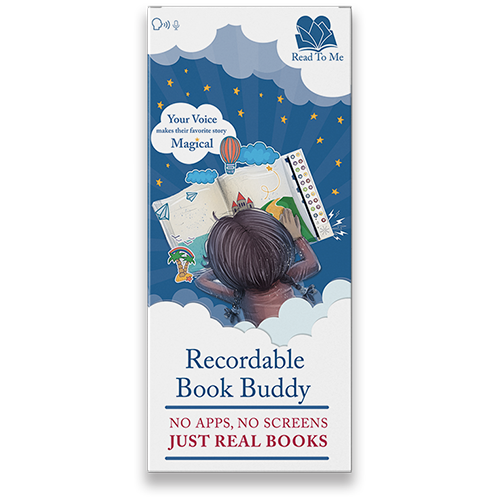
That is the heart behind the Read To Me Recordable Book Buddy: helping families turn any children’s picture book into a personalized read along experience, using the voice of someone the child loves.
Give Kids More Real-World Responsibility
Let kids help cook. Let them carry the library books. Let them build something, decorate something, mail something, walk somewhere age-appropriate, or make a plan.
Confidence does not come from being protected from every challenge. It comes from discovering, “I can do this.”
Model the Behavior
This is the hard one.
Kids notice when adults say “too much screen time” while checking their own phones all evening. Family screen habits work better when everyone participates.
A phone basket, a bedtime charging station outside the bedroom, or a shared reading hour can help make the change feel like a family decision instead of a punishment.
The Bigger Takeaway
The Anxious Generation is not just a book about phones. It is a book about childhood.
It asks an uncomfortable question: What have kids lost as screens have taken up more of their time, attention, and emotional lives?
But it also offers a hopeful answer. Families can reclaim real-world childhood. Schools can protect attention. Parents can coordinate instead of going it alone. Kids can have more freedom, more play, more responsibility, more books, more face-to-face connection, and more time to become themselves without a screen constantly pulling them away.
For any parent, grandparent, teacher, or caregiver trying to understand childhood anxiety, screen time, social media, and the need for healthier family routines, The Anxious Generation is worth reading.
You can buy The Anxious Generation here or learn more at the official book site, AnxiousGeneration.com.
Related Resources
Buy The Anxious Generation by Jonathan Haidt
Official The Anxious Generation website
Parent Action Guide from AnxiousGeneration.com
U.S. Surgeon General Advisory on Social Media and Youth Mental Health
CDC Youth Risk Behavior Survey Results
American Psychological Association Health Advisory on Social Media Use in Adolescence
Read To Me Recordable Book Buddy
Read article